Military Life Keeps Its Promise to Service Members. What About Their Families?
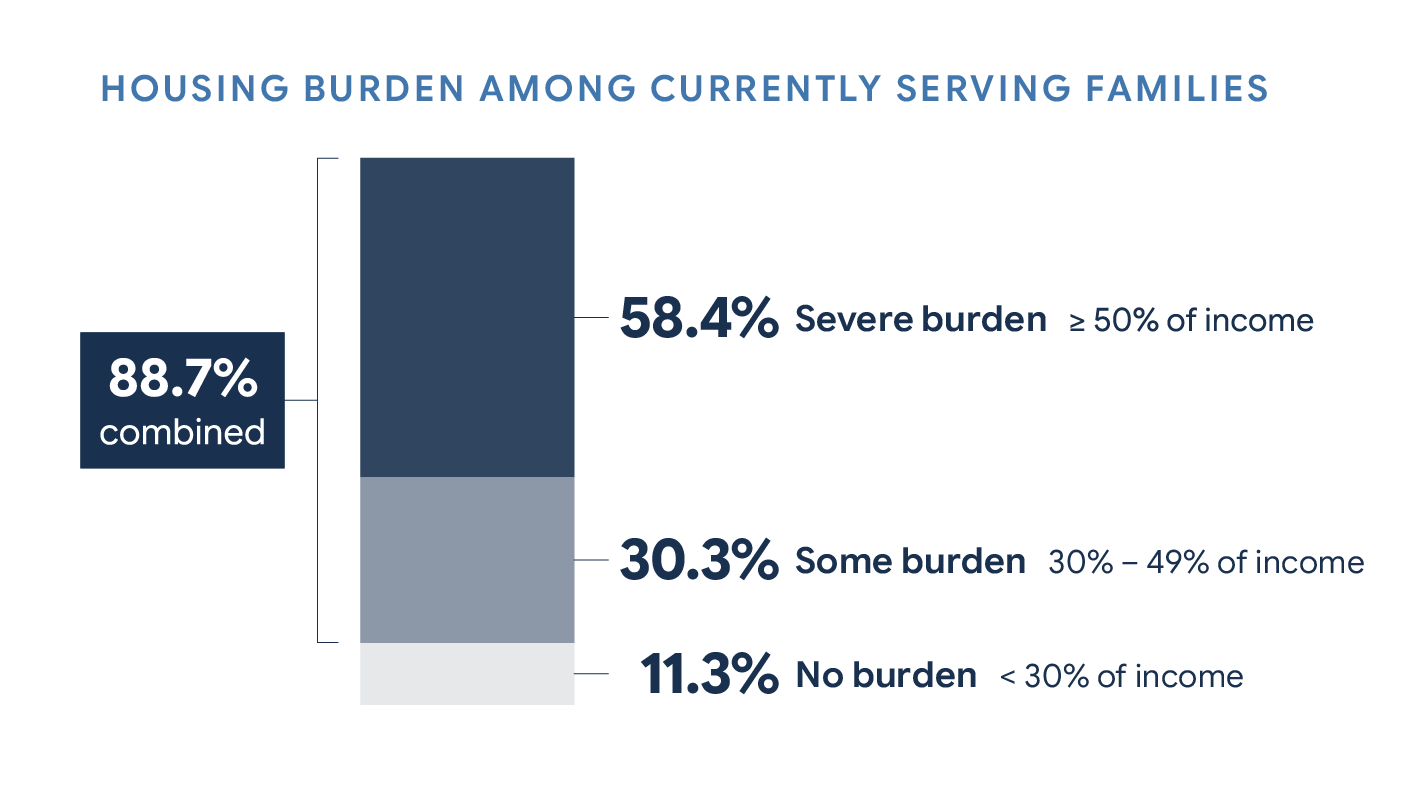
November 05, 2026Nine in ten currently serving military families spend at least 30 percent of what they earn on housing and utilities. Nearly six in ten spend more than half. The national average is about one-third of households.
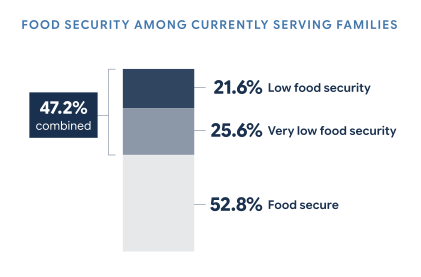
Nearly half of these military families do not have reliable access to enough food, and one in four sits in the most severe category the federal scale defines. More than half carry a high invisible family load: the work of anticipating, coordinating, and remembering that keeps a household running. That load does get less with rank or pay. It burdens the person managing the household schedule.
What is new
Military families have told us about these conditions for years. What our newest research has shown us is how they relate to one another. For the first time, our research examines the factors impacting military families while accounting for several at once, which lets us ask not only which families are struggling, but which pressures actually create the outcomes we care about once everything else is held steady.
These findings draw on our 2025 Military Family 360 Survey, through which we heard from more than 10,000 people between October 2025 and January 2026. We examined 6,553 currently serving families in detail. We were in the field during a federal government shutdown, when roughly 50,000 families came to us for emergency support and many National Guard and Reserve families missed a paycheck their active duty counterparts did not.
The measure at stake
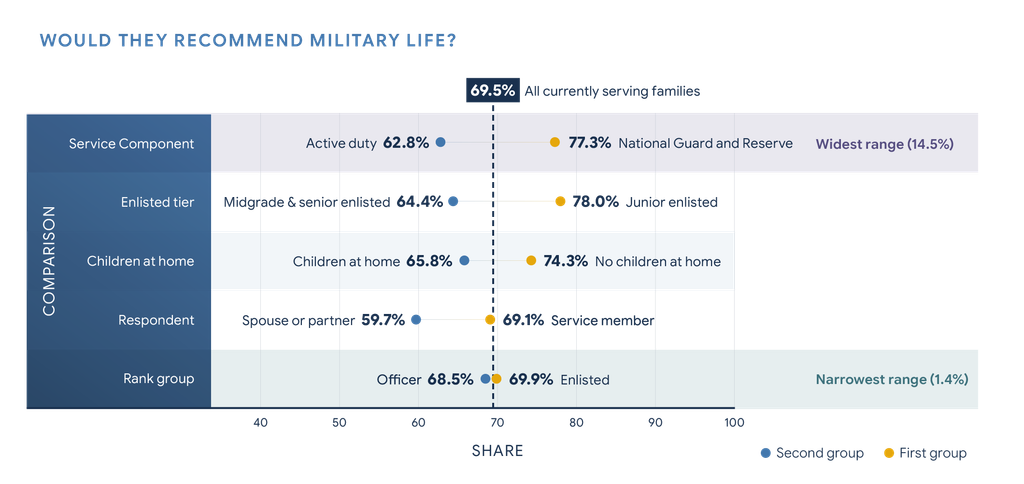
Nearly seven in ten currently serving families, 69.5 percent, would recommend a career in the military to someone they care about. That figure is not a reassurance. It is the measure at stake. Our goal was to establish what separates the families who answered yes from those who did not, because that difference is the clearest signal available about whether military life will be passed on.
Household income does not account for it. Families earning more are, if anything, slightly less likely to recommend service once their well-being is taken into account. Rank does not account for it either, despite sorting families on nearly every financial measure in this study. Neither does how healthy or how connected a family reports itself to be.
The measure that does explain why a family would not recommend this life is how military life compared with what a family expected of it.
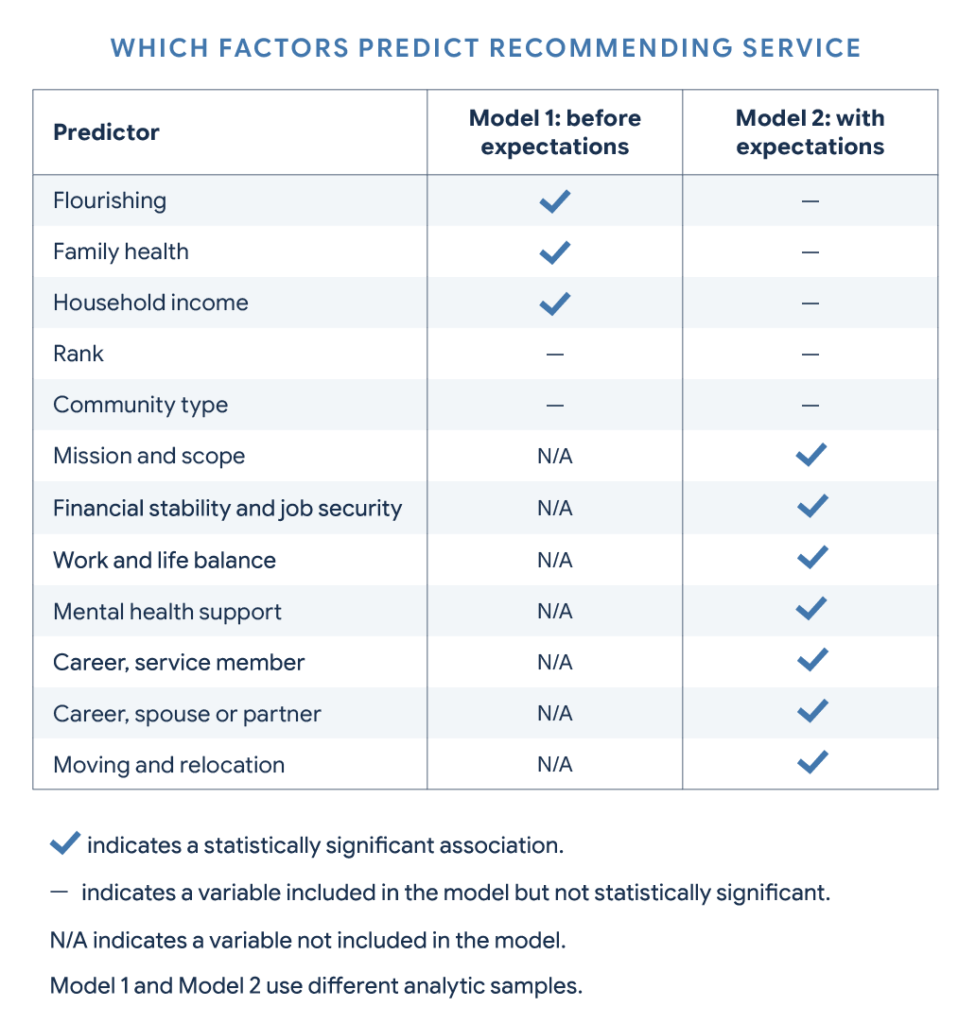
Military families do not expect a life of service to be easy, but many did not expect it to be this hard. When the realities of military life fall short of what families anticipated, their willingness to recommend service is at greatest risk. That is my reading of what this shows, and it is the thing I cannot stop thinking about.
Where military life keeps its promises, and where it does not
We asked families to compare eleven areas of military life with what they expected when service began.
Mission and scope hold up best. Fewer than a quarter of families report that it fell short, and it is among the areas tied to whether a family would recommend this life. After this factor, the pattern reverses. Spouse and partner career opportunity falls below what families expected for more than six in ten. Household work and life balance falls short for more than half. So does mental health support. So does support for children’s needs.
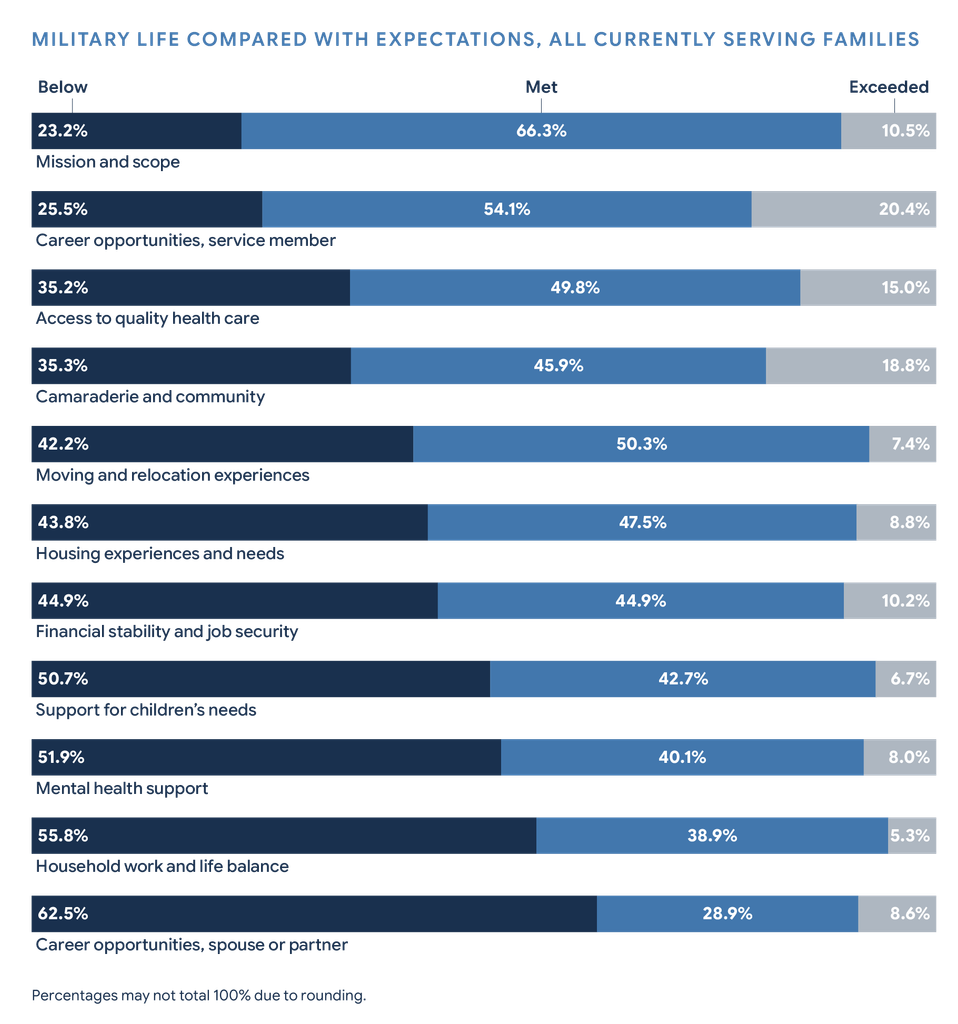
Military life is keeping its promises to the person in uniform and to the mission, but falls short of what it led the family to expect. That gap in expectations, rather than hardship in itself, separates the families who would recommend this life from those who would not.
Why better benefits alone will not address this
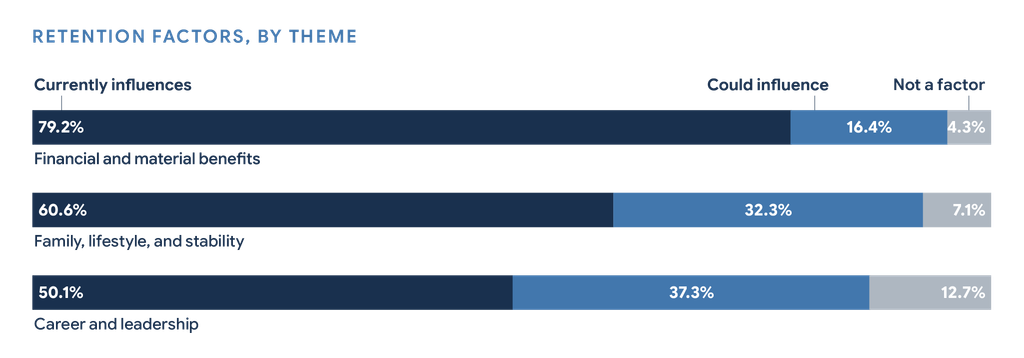
We asked families to weigh thirteen factors that might hold them in service. Pay, health care, housing, retirement, and education benefits taken together already influence the decision to stay for four in five families. Improving them further reaches a shrinking share of the force, not because families have everything they need, but because these factors are already in play for almost everyone.
Career and leadership factors are where the opportunity for intervention resides. They currently influence the decision to stay for half of families, and a further third say they could recommend military life if those factors were offered or improved. No other factor in the set showed that much unrealized reach, and it lives outside the benefits package.
What we intend to pursue
Five areas give us enough evidence to act on. Each identifies a specific mechanism rather than a general condition, which is how we have approached housing, food insecurity, and tenant protections before.
- Define what families can expect from military life, and close the gap between that promise and their experience. Today, there is no shared understanding today of what service should offer a family, or where responsibility for support begins and ends. Expectations take shape through recruiters, command climate, and what families hear from one another.
- Review how housing allowances are set relative to local cost, and build a system that anticipates rather than reacts. Families at identical incomes encounter different burdens depending on rank and community. They bear the cost, and often debt, while they wait for a correction.
- Use food security to identify financial risk earlier. Food insecurity tells us more about a recent financial emergency than income or housing costs do, and families just outside the federal definition face nearly the same elevated risk as those inside it.
- Make child care an urgent workforce and readiness priority. Half of families with children say inadequate care has affected household employment, and family responsibilities are nearly four times as likely as relocation to limit spouse work.
- Look at total time away to better understand the impact on families. Families report poorer health past roughly six months of cumulative time away, while the number of deployments shows no measurable relationship. We cannot separate time away from household income here, so we cannot say it drives the decline. The services already collect the information needed to look into this further.
What this means
Two things are true at once here, and both belong in any full account of military family life.
The strain is real, widespread, and concentrated in ways that can be identified and addressed. Most of those same families would still recommend this life to someone they love.
But the future of the all-volunteer force depends on the families who know military life best. We often say that we recruit the service member and retain the family. This research gives that saying a concrete form, and it shows us a clear opportunity: define what families can expect from military life, and then deliver on it.
Families have told us where that gap is widest. Turning that into action is the work, and MFAN will keep pressing for it with those ready to act.
About the Author