Military Families & the Future of Service
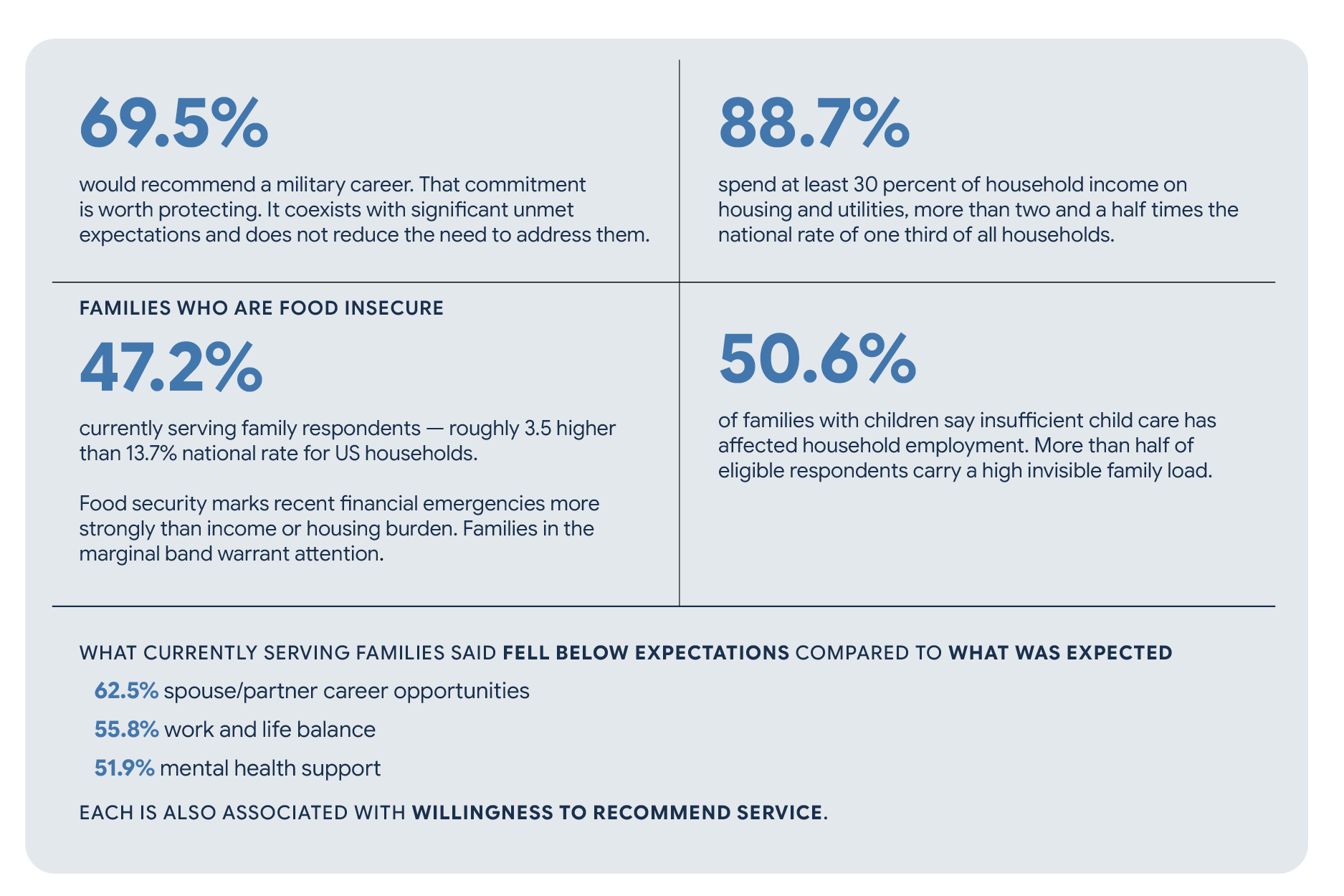
The National Profile is MFAN’s first multivariate analysis revealing the connections among family experiences and how they relate to families’ willingness to recommend military service. Most currently serving families would recommend a military career to someone they care about. What separates them from those who would not is not how much hardship they carry, what they earn, or where they sit in the rank structure. It is whether military life matched what they anticipated of it.


MEDIA INQUIRIES
Members of the media seeking interviews or additional information about the National Profile can contact MFAN’s communications team.
Military life is largely meeting what families expected of the mission and of the service member’s role. Where it falls short is on the family side: spouse and partner careers, work and life balance, mental health support, and support for children’s needs. Three of those four are independently associated with willingness to recommend service. For defense leaders, policymakers, advocates, philanthropy, and community partners, that makes the gap both specific and addressable
The Key Takeaways
What the analysis found
The expectations gap is what separates families
Respondents compared eleven areas of military life with what they anticipated when service began. Mission and scope hold up best, falling short for fewer than a quarter of families. Below it, the pattern reverses onto the areas belonging to the family rather than the service member.
Modeled together with rank, household income, service component, community type, and children at home, it is the expectations measures that continue to predict whether a family would recommend service. Income and family well-being each predict that answer on their own and stop doing so once expectations enter. Rank does not predict it at any stage, despite sorting families on nearly every financial measure in the study.
Financial strain is widespread, and food security finds it earliest
Close to nine in ten families deal with a housing burden, and relief appears only at the two highest-income brackets. Families at identical incomes face different burdens depending on rank and on community type, which points at how allowances are set relative to local cost rather than at household pay.
Child care and the work of running a household
Half of families with children report that insufficient child care has affected employment in the household, and that cost falls hardest on spouse and partner respondents and on midgrade enlisted families. Family responsibilities, not relocation, are the dominant constraint on spouse employment, by nearly four to one.
More than half of eligible respondents carry a high invisible family load, the work of anticipating, coordinating, and remembering that keeps a household running. That load does not track with rank. It tracks with children at home and with active duty status, which means the measures that identify families for financial support do not locate the same households.
Food security
Just over half of families, 52.8 percent, are food secure. The remainder fall below the threshold, with 21.6 percent at low food security and 25.6 percent at very low food security. Food insecurity therefore reaches 47.2 percent of currently serving families, and roughly one in four sits in the most severe category.
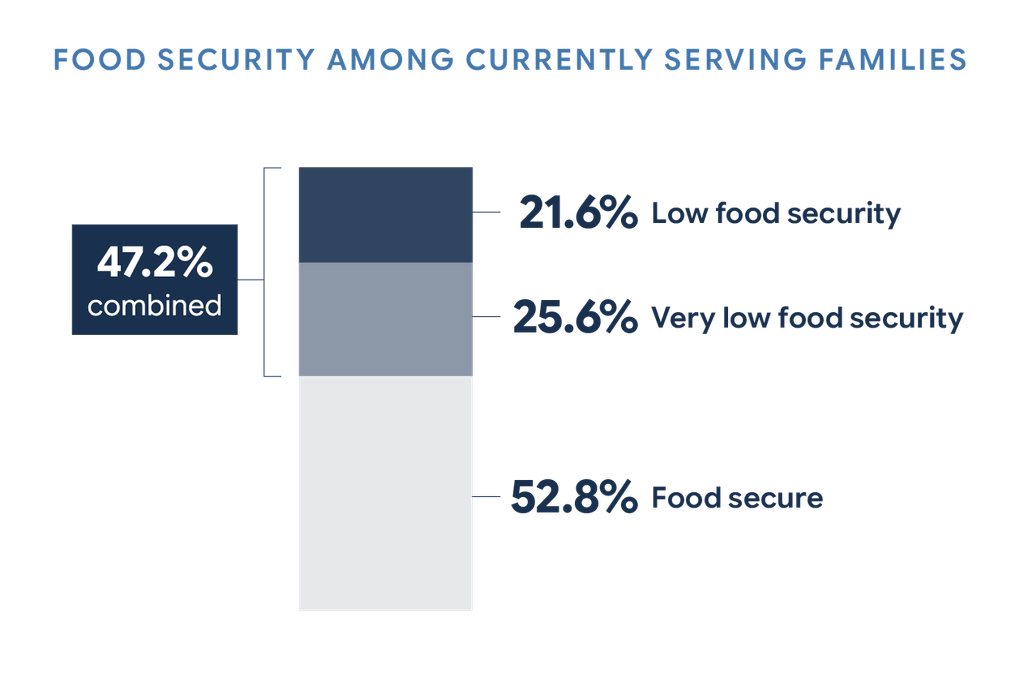
Food security carries more information about a family’s recent financial history than either income or housing burden. In the model of financial emergency recency, neither remains significant once food security is included. Families answering a single item affirmatively, who are classified as food secure in the marginal band, are burdened with almost the same elevated risk of families formally counted as food insecure.
Food insecurity concentrates by rank and by family composition. Enlisted families report worse food security than officer families, one of the stronger associations in the analysis, and families with children report worse food security than families without.
Because the data are cross-sectional, the analysis cannot establish sequence. A financial emergency may push a household into food insecurity, food insecurity may deepen until it becomes an emergency, or the two may arise together. For the purpose of identifying families at risk, the ordering does not change the result. Food security locates families at the edge of a household budget more reliably than income does.
A shared agenda for improving family experiences
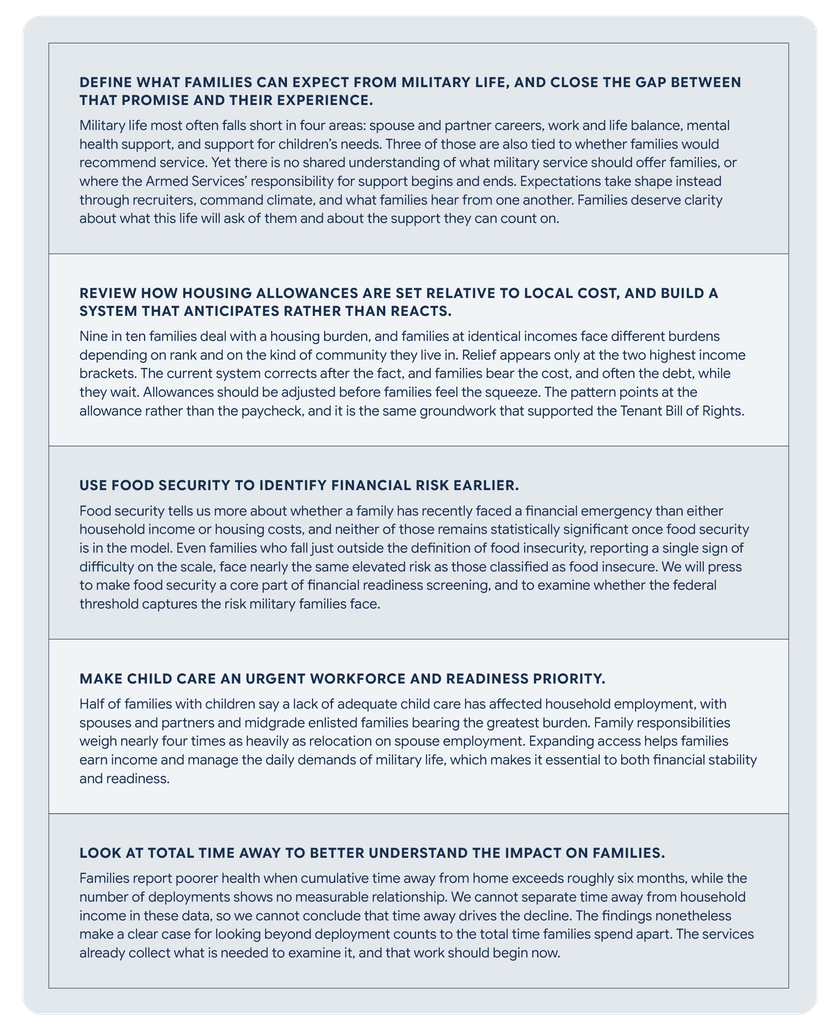
We identified five priorities where policy, leadership, advocacy, philanthropy, and community delivery can reinforce one another.
Research Notes
The analysis draws on 6,553 currently serving family respondents to the 2025 Military Family 360 Survey. Findings are unweighted and reflect a non-probability sample with greater active duty and Army representation. They establish associations, not causes or trends.
This profile builds on the Military Family 360 Report released in June 2026. That report describes family experiences in depth. This analysis examines their distribution and the relationships among them. Full methods, model specifications, tests, and references are in the National Profile.
The sample is not a probability sample and estimates are unweighted. Enlisted representation closely matches the 2023 force benchmark, while active duty and Army respondents are overrepresented. Headline percentages describe respondents and should not be presented as precise population prevalence estimates.
The survey captures one period. It establishes associations, not causal effects, changes over time, or validated forecasts. Reports of declining satisfaction are retrospective accounts rather than measured population trends.
The field period included a federal government shutdown. Findings about recent emergencies, particularly among Guard and Reserve families, may reflect interrupted pay during that period.
Related Research
- 2025 Military Family 360 Report (June 2026)